Choosing bunk beds for low ceilings means balancing usable sleeping space with safe headroom, sturdy construction, and easy access to the top bunk.
These 10 picks cover low-profile wood and metal frames, floor-style designs, built-in storage, ladders, guardrails, and family-friendly features for compact bedrooms.
Best 10 Bunk Beds for Low Ceilings Picks for 2026
Best Low-Profile Wood Pick
Max & Lily Fundamental Twin Low Bunk Bed

- 49.25-inch height suits low-ceiling rooms
- Solid pine frame supports up to 400 pounds
- Non-toxic finish and 14-inch guardrails
Best For: Families wanting a simple, low wooden bunk bed
Best Storage-Rich Corner Design
Twin Over Twin Low Bunk Bed with Drawers
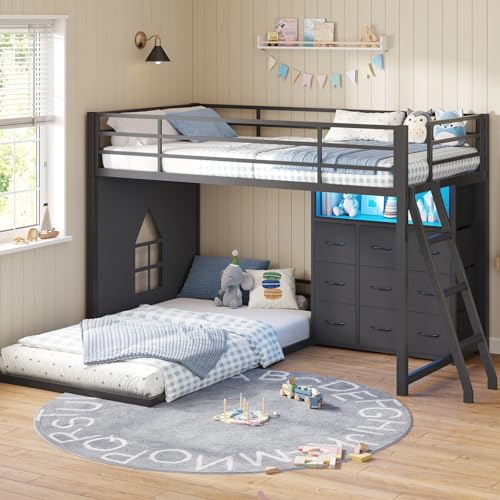
- L-shaped layout fits neatly into corners
- Nine drawers plus an open shelf add storage
- Floor-level lower bed and RGB lighting
Best For: Families needing built-in organization in a compact room
Best Simple Budget-Style Option

- 46.5-inch height maximizes ceiling clearance
- Solid wood frame with 14 stabilizing slats
- Convertible lower bed supports play or storage
Best For: Families wanting a basic, low twin bunk with flexible use
Best Feature-Packed Staircase Model
ADORNEVE Low Bunk Bed with Storage Staircase

- 54.1-inch height with stair access and handrails
- Three drawers and two shelves add organization
- RGB lights and built-in charging hub
Best For: Kids' rooms needing stairs, storage, lighting, and charging
Best Wood Pick
Max & Lily Fundamental Twin Low Bunk Bed

- 49.25-inch low-profile height
- Solid pine with non-toxic finish
- 14-inch guardrails and 400-lb capacity
Best For: Children’s rooms needing a low wooden bunk bed
Best Heavy-Duty Metal Pick
Twin Over Twin Metal Floor Bunk Bed

- 58.1-inch low-profile height
- 550-pound weight capacity
- Rounded frame with guardrails and anti-tip device
Best For: Shared spaces needing a durable metal bunk bed
Best for Tight Clearances
Zevemomo Twin Over Twin Low Bunk Bed

- 54.09-inch height for low ceilings
- Flexible side-ladder placement
- 350-lb upper and 400-lb lower capacity
Best For: Small children’s rooms with limited ceiling clearance
Best Low Metal Bunk

- 53.94-inch low-profile height
- 400-pound maximum weight recommendation
- Guardrails, ladder, and anti-tip hardware
Best For: Shared kids’ rooms with lower ceilings
Best Low Wood Bunk

- 47.64-inch overall height
- Solid pine with hardwood slats
- Reversible ladder and full guardrails
Best For: Kids’ rooms where maximum ceiling clearance matters
Best Low Bunk With Storage
Twin Over Twin With Storage Stairs

- 54-inch low-profile design
- Drawers, shelves, and storage stairs
- Outlets, USB ports, and RGB lighting
Best For: Small rooms needing storage and charging access
Best Low-Profile Wood Pick – Max & Lily Fundamental Twin Low Bunk Bed
If you need bunk beds for low ceilings, the Max & Lily Fundamental stands out for its 49.25-inch height and streamlined twin-over-twin design. Its solid-wood construction, 14-inch guardrails, and easy-access lower bed make it a practical choice for younger children and compact rooms.
Best For: Families wanting a simple, low wooden bunk bed with strong weight support and easy lower-bed access.
Pros:
- Low 49.25-inch profile helps preserve headroom in rooms with low ceilings.
- Solid pine construction, strong slats, a metal support bar, and metal-on-metal bolt connections support up to 400 pounds.
- Non-toxic finishes and tall guardrails provide a safety-focused design.
- Does not require a box spring or bunkie board and is recommended for 5- to 8-inch mattresses.
Cons:
- The simplified design has fewer headboards and a more minimal appearance.
- It is available for twin mattresses only.
At 80 by 54.25 by 49.25 inches, this is one of the more straightforward options for maximizing headroom without giving up two sleeping surfaces. Its restrained styling may be especially appealing for shared children’s rooms.
Best Storage-Rich Corner Design – Twin Over Twin Low Bunk Bed with Drawers
For bedrooms where floor space and storage are equally limited, this L-shaped low bunk bed combines two twin sleeping areas with nine drawers and an open shelf. Its floor-level lower bed and app-controlled RGB lighting add practical and recreational features, though its overall setup is more feature-heavy than a basic bunk.
Best For: Families needing a corner-oriented bunk with built-in toy, clothing, and book storage.
Pros:
- L-shaped low-profile layout fits into a bedroom corner and places the lower mattress directly on the floor.
- Nine fabric storage drawers and a one-tier shelf help organize toys, clothes, bedding, and books.
- The upper bunk includes a 13.4-inch full-length guardrail, anti-tip device, and inclined padded ladder.
- RGB LED lighting offers adjustable brightness, color options, and music-sync mode.
Cons:
- The L-shaped configuration may require more planning than a vertically stacked bunk.
- Two adults are recommended for assembly.
- The listing describes a metal, MDF, and fabric construction rather than an all-wood frame.
This model is a strong match for compact children’s rooms that need more than sleeping space. Before buying, measure the corner and confirm that the L-shaped arrangement works with your room’s doors and furniture.
Best Simple Budget-Style Option – Solid Wood Floor Bunk Bed
This solid-wood floor bunk bed keeps the design simple while addressing the main concern in rooms with low ceilings: overall height. At 46.5 inches tall, it offers two twin beds, full-length guardrails, and a three-step ladder without adding bulky storage or lighting features.
Best For: Families seeking a straightforward, low-height twin bunk with a convertible lower-bed design.
Pros:
- Its 46.5-inch height is particularly well suited to low-ceiling bedrooms.
- Solid wood construction and 14 slats are designed for stability and reduced shaking.
- A 13.4-inch full-length guardrail and wide three-step ladder support safer climbing.
- The lower bed can be used for sleeping, play, or storage, and no box spring is needed.
Cons:
- The gray design has fewer built-in features than storage- or lighting-equipped alternatives.
- Assembly is required, even though hardware and instructions are included.
Measuring 79.1 by 42 by 46.5 inches, this is a useful choice when ceiling clearance is the priority. Its uncomplicated layout also makes it easier to fit into bedrooms, guest rooms, dormitories, or other multipurpose spaces.
Best Feature-Packed Staircase Model – ADORNEVE Low Bunk Bed with Storage Staircase
The ADORNEVE combines a relatively low 54.1-inch height with a storage staircase, shelves, lighting, and a built-in power hub. For shoppers comparing bunk beds for low ceilings, its stair-based entry and wraparound rails are useful safety features, but the 92-inch length and extra electronics require careful room planning.
Best For: Children’s rooms that need safer stair access, organized storage, and integrated lighting and charging.
Pros:
- The 54-inch-tall design includes handrails, curved entry edges, and wraparound upper-bunk rails.
- Three staircase drawers and two open shelves provide convenient storage.
- Under-bed RGB lighting offers color and music-synchronization options.
- The suspended power hub includes two AC outlets, USB-A, and USB-C ports.
Cons:
- At 92 inches long, it may need more wall space than the other listed options.
- Its stated maximum weight capacity is 220 pounds.
- Assembly requires two people and is estimated at about 1.5 hours.
This is the most amenity-rich choice in the group, with the staircase doing double duty as access and storage. Verify both ceiling clearance and floor length before choosing it, especially in a small bedroom.
Best Wood Pick – Max & Lily Fundamental Twin Low Bunk Bed
For shoppers comparing bunk beds for low ceilings, the Max & Lily Fundamental stands out with a 49.25-inch overall height and a low-profile twin-over-twin layout. Its solid-pine construction, non-toxic finish, and streamlined lower bunk make it a practical choice for children’s rooms where headroom and easy access matter.
Best For: Families seeking a low wooden bunk bed for younger children and compact bedrooms.
Pros:
- Low 49.25-inch height helps preserve headroom.
- Solid wood frame with strong slats, a metal support bar, and metal-on-metal bolt connections.
- 14-inch guardrails and a 400-pound maximum weight recommendation.
- Non-toxic finish and no box spring or bunkie board required.
Cons:
- The twin-over-twin configuration is not available for larger mattress sizes.
- The recommended 5- to 8-inch mattress range may limit mattress choices.
This is a particularly well-rounded option when a wood frame, lower top bunk, and child-focused safety features are priorities. Its 80-inch length and 54.25-inch width should still be measured against the room before ordering.
Best Heavy-Duty Metal Pick – Twin Over Twin Metal Floor Bunk Bed
Among bunk beds for low ceilings, this twin-over-twin metal floor bunk bed uses a 58.1-inch low-profile design to reduce the height of the upper sleeping surface. Its round-pipe frame, full-length guardrails, and 550-pound weight capacity make it a flexible option for shared bedrooms, dorms, guest rooms, or cabins.
Best For: Kids, teens, or adults who want a sturdy metal bunk bed with a relatively low profile.
Pros:
- Low-profile structure is designed to reduce top-bunk height.
- Heavy-duty metal frame supports up to 550 pounds.
- Rounded pipe construction provides smoother edges without sharp corners.
- Includes ladders, full-length guardrails, an anti-tip device, and assembly hardware.
Cons:
- At 58.1 inches tall, it is higher than the other low-profile options in this roundup.
- The metal frame may offer a less traditional look than a wood bunk bed.
This model makes sense when weight capacity and metal durability are more important than achieving the absolute lowest height. Confirm the 76.8-by-42-inch footprint and available ceiling clearance before assembly.
Best for Tight Clearances – Zevemomo Twin Over Twin Low Bunk Bed
The Zevemomo twin-over-twin bunk bed is explicitly designed for small spaces and low ceilings, with a 54.09-inch overall height. Its metal frame combines full-length upper guardrails, side ladders, 22 reinforced slats, and noise-reducing features for a practical setup in a children’s room.
Best For: Families needing a compact metal bunk bed with flexible ladder placement and low-ceiling compatibility.
Pros:
- 54.09-inch height suits rooms with limited overhead clearance.
- Side ladders allow more flexible placement.
- Full-length 11-inch guardrail helps protect the upper bunk.
- Supports up to 350 pounds on the upper bunk and 400 pounds on the lower bunk.
Cons:
- It is available only in a twin-over-twin configuration.
- Assembly is described as requiring two people, despite the included tools and instructions.
With a shorter profile than many standard bunk beds and a footprint of approximately 76.69 by 40.94 inches, this is a strong space-conscious choice. Its powder-coated metal frame and slat-lock design also add practical durability and help minimize noise.
Best Low Metal Bunk – Heavy-Duty Twin Over Twin
For shoppers comparing bunk beds for low ceilings, this twin-over-twin metal model stands just 53.94 inches tall. Its compact vertical profile provides two sleeping spaces while leaving more overhead clearance than a traditional bunk bed.
Best For: Kids’ rooms, shared bedrooms, and lower-ceiling spaces needing a sturdy, space-conscious bunk.
Pros:
- Low 53.94-inch overall height suits rooms with lower ceilings.
- Full-length, 16.14-inch guardrails surround the upper bunk.
- Metal frame supports up to 400 pounds and requires no box spring.
- Built-in ladder, anti-tip devices, non-slip feet, and slat-fixing buckles add practical stability features.
Cons:
- Uses a vertical ladder rather than storage stairs.
- Metal construction may offer a different look and feel than a wood bunk bed.
- Wall attachment is required for the included anti-tip devices.
This is a straightforward low-profile choice for families prioritizing ceiling clearance, durable metal construction, and a compact footprint over built-in storage or extra features.
Best Low Wood Bunk – Solid Pine Twin Over Twin
This solid pine bunk bed is a practical option for bunk beds for low ceilings, measuring 47.64 inches high. The especially low profile helps preserve overhead space in smaller children’s rooms while maintaining two twin sleeping levels.
Best For: Children’s bedrooms and small, low-ceiling rooms where a wood frame and flexible ladder placement are priorities.
Pros:
- 47.64-inch height is notably low for a twin-over-twin bunk.
- Solid pine frame and hardwood slats provide everyday support.
- Reversible ladder can be installed on either side to suit the room layout.
- Includes full-length 11-inch guardrails and needs no box spring.
Cons:
- Maximum load is 264.5 pounds, lower than some heavier-duty options.
- Mattresses are not included, and a 4- to 6-inch mattress is recommended.
- Assembly is required.
With the lowest listed height in this roundup, this JOYMOR model is a strong fit when ceiling clearance is the main concern. Its reversible ladder also makes it easier to adapt to different bedroom layouts.
Best Low Bunk With Storage – Twin Over Twin With Storage Stairs
For families seeking bunk beds for low ceilings without giving up organization, this metal twin-over-twin model stands about 54 inches tall. Its integrated stairs add drawers and shelves, while the compact vertical design keeps sleeping space practical in smaller rooms.
Best For: Kids’ rooms, apartments, or dorm-style spaces that need low-profile sleeping space plus built-in storage and charging features.
Pros:
- Approximately 54-inch height works well in lower-ceiling rooms.
- Storage stairs include pull-out drawers and side shelves.
- Built-in charging station provides two AC outlets, USB-A, and USB-C ports.
- RGB LED lighting, full-length guardrails, reinforced slats, and an anti-tip device add useful features.
Cons:
- At 94 inches long, it requires more floor length than the other listed models.
- Its metal-and-MDF construction is heavier at 108 pounds.
- Extra electrical and lighting features may be unnecessary for shoppers wanting a simple bunk.
This model is the feature-rich choice for low-ceiling rooms where storage and bedside convenience matter. Measure carefully for its longer footprint, and consider whether the stairs, charging station, and lighting justify the added complexity.
How We Picked the Best Bunk Beds for Low Ceilings
We focused on designs that reduce the height of the upper sleeping platform or place the lower bunk close to the floor. Our evaluation criteria included overall frame height, guardrail coverage, ladder access, materials, weight capacity, mattress support, assembly requirements, and useful space-saving features. We also included both simple frames and storage-equipped models so shoppers can match the bed to the room and budget.
Before ordering, verify the manufacturer’s dimensions rather than relying only on the product name. Ceiling height, mattress thickness, floor-to-ceiling clearance, and the child’s sitting height all affect comfort and safety.
Quick Comparison
| Design | Best For | Main Advantage | Potential Trade-Off |
|---|---|---|---|
| Low solid-wood bunk | Families prioritizing stability | Warm appearance and robust slat support | Usually heavier to move |
| Metal low bunk | Budget-conscious rooms | Lightweight, practical construction | May transmit more movement or noise |
| Floor bunk | Very low ceilings or younger children | Lower top-bunk height | Less under-bed storage |
| Storage bunk | Shared rooms needing organization | Drawers, shelves, or stairs add utility | Requires more floor space and assembly |
Key Buying Factors for Bunk Beds for Low Ceilings
Measure Vertical Clearance
Measure from the floor to the ceiling, then account for the mattress thickness and the space above the top mattress. A child should be able to sit without hitting the ceiling or feeling cramped. Check the listed overall height, not just the distance between bunks.
Prioritize Guardrails and Safe Access
Look for a full-length guardrail on the upper bunk, a securely attached ladder, and rounded or finished edges. Follow the manufacturer’s age guidance and use the recommended mattress thickness so the guardrail remains tall enough above the mattress.
Compare Materials and Support
Solid wood can provide a substantial, stable feel, while metal frames may be easier to reposition. Strong slats and a compatible mattress foundation are essential; many listed designs do not require a box spring. Confirm the weight limit for each sleeping level.
Account for Storage and Assembly
Stairs, drawers, shelves, outlets, and LED lighting can be helpful, but they increase the bed’s footprint, price, and assembly time. Measure doorways and walking paths before selecting a larger storage configuration.
Who Should Buy Which Bunk Beds for Low Ceilings?
Choose a floor-style or very low wood bunk when ceiling clearance is the primary concern or the room is intended for younger children who need easier access.
Choose a low solid-wood frame if stability, durable slats, and a classic appearance matter more than minimizing weight. These models are often a good fit for long-term use in children’s rooms.
Choose a metal frame for a straightforward, space-efficient option that is often easier to move and maintain. Check reviews and hardware details if minimizing noise is important.
Choose storage stairs or drawer-equipped designs when the bedroom lacks closet space and has enough floor area for a wider footprint. For any option, recheck measurements, assembly instructions, and safety requirements before allowing a child to use the upper bunk.