Excess humidity can damage stored belongings, encourage mold growth, and make a basement feel persistently damp. The best commercial dehumidifier for basement use combines high moisture-removal capacity with dependable drainage and controls suited to long runtimes.
We’ve selected 10 high-capacity models ranging from compact commercial units to powerful 180-pint machines. Use the comparison and buying advice below to match capacity, drainage, coverage, and operating features to your space.
Best 10 Commercial Dehumidifier for Basement Picks for 2026
Best Overall
Waykar 150 Pint Commercial Dehumidifier

- Up to 150-pint daily moisture removal
- Built-in pump plus gravity-drain options
- Rated for spaces up to 7,000 sq. ft.
Best For: Large basements needing flexible continuous drainage
Best for Energy Efficiency
AEOCKY 8000-Sq.-Ft. Commercial Dehumidifier

- ENERGY STAR Most Efficient 2025 certified
- Rated for spaces up to 8,000 sq. ft.
- Designed for low-temperature operation
Best For: Large basements with frequent, extended runtimes
Best User-Friendly Option
Kesnos 150 Pint Basement Dehumidifier

- Covers up to 7,500 sq. ft.
- Front humidity display with sleep mode
- Tank or continuous-hose drainage
Best For: Basements needing simple monitoring and quiet operation
Best Compact Commercial Unit
Airecoler 125-Pint Dehumidifier
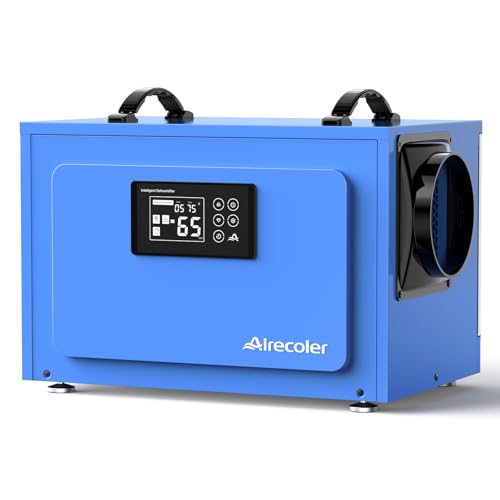
- Compact design for tight crawlspaces
- 125-pint maximum capacity
- Includes 6.56-foot drain hose and auto defrost
Best For: Low-clearance basements and crawlspaces
Best Large-Capacity Pick
155 Pint Commercial Dehumidifier with Pump

- 155-pint maximum capacity with 70 PPD AHAM rating
- Built-in pump and gravity-drain options
- Energy Star certified with automatic defrost
Best For: Large basements, crawl spaces, and extended unattended operation
Best for Restoration Work
Abestorm 180 PPD Commercial Dehumidifier

- 85 PPD AHAM capacity and 210 CFM airflow
- 19.6-foot hose with built-in pump
- Wheels, handles, auto defrost, and MERV-8 filter
Best For: Basement drying and water-damage restoration
Best for Mobility
160 Pint Commercial Dehumidifier with Pump

- 160-pint capacity with 265 CFM airflow
- 16.4-foot pump range and included drain hose
- 10-inch wheels and detachable handles
Best For: Large spaces and job sites requiring frequent repositioning
High-Capacity Pick
155 Pint Commercial Basement Dehumidifier

- Covers up to 6,500 square feet
- ENERGY STAR certified with 2.01 IEF
- Continuous gravity drainage and auto restart
Best For: Large basements, crawl spaces, and restoration sites
Pump-Drain Specialist
110 Pint LGR Commercial Dehumidifier

- Built-in pump with 19.6-foot hose
- Dual RH and GPP humidity modes
- Wheels, auto defrost, and memory function
Best For: Commercial basements and restoration work
Low-Clearance Choice
155 Pint Crawl Space Dehumidifier
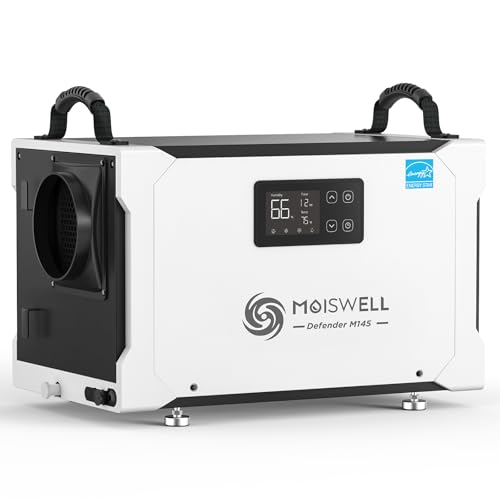
- Horizontal design fits tight spaces
- Covers up to 6,000 square feet
- Auto drain, defrost, timer, and restart
Best For: Low-clearance crawl spaces and compact basements
Best Overall – Waykar 150 Pint Commercial Dehumidifier
For large, persistently damp areas, the Waykar 150 Pint is a capable commercial dehumidifier for basement use. It is rated for spaces up to 7,000 square feet and combines adjustable humidity control with multiple drainage options, including a built-in pump.
Best For: Large basements, crawlspaces, garages, wine cellars, and other areas that need continuous moisture removal without frequent tank emptying.
Pros:
- Removes up to 150 pints per day under listed test conditions and covers up to 7,000 square feet.
- Built-in pump supports upward drainage up to 9.84 feet, while a drain hose supports gravity drainage.
- Includes Energy Star certification, auto defrost, self-drying, automatic restart, and adjustable humidity control.
- Casters, a handle, swing function, and cord storage improve portability and setup.
Cons:
- The included drain hose is only 3.3 feet long.
- The pump function may need to be reset after unplugging following a normal shutdown.
- Its large-capacity design may be more than needed for smaller rooms.
The Waykar stands out when drainage flexibility is a priority. Its pump and large coverage rating make it particularly practical for unattended basement operation, provided the installation area can accommodate its commercial-size footprint.
Best for Energy Efficiency – AEOCKY 8000-Sq.-Ft. Commercial Dehumidifier
The AEOCKY RHEA-003 is an appealing commercial dehumidifier for basement buyers who prioritize efficiency alongside high moisture-removal capacity. It is rated for up to 8,000 square feet and carries the ENERGY STAR Most Efficient 2025 designation.
Best For: Large homes and basements where long runtimes, lower energy use, accurate humidity control, and low-temperature operation are important.
Pros:
- Rated at 140 pints per day at 95°F/95% RH and 95 pints per day at 86°F/80% RH.
- ENERGY STAR Most Efficient 2025 certification emphasizes efficient operation.
- Designed to continue operating in lower-temperature conditions with advanced defrost sensors.
- Power-off memory and precise humidity monitoring support convenient automated use.
Cons:
- The supplied notes do not specify a built-in pump or included drain hose.
- Its performance figures vary substantially with temperature and relative humidity.
- The feature-heavy design may be unnecessary for smaller or occasionally damp spaces.
For a basement that runs a dehumidifier frequently, the AEOCKY’s efficiency credentials and broad coverage are its main advantages. Confirm the drainage setup and available space before choosing it for a permanent installation.
Best User-Friendly Option – Kesnos 150 Pint Basement Dehumidifier
The Kesnos JD-N is a straightforward commercial dehumidifier for basement spaces up to 7,500 square feet. Its front humidity display, sleep mode, washable filter, and two drainage choices make it convenient for routine residential or light commercial moisture control.
Best For: Homeowners who want visible humidity readings, quieter nighttime operation, and flexible room-to-room placement.
Pros:
- Removes up to 150 pints per day under listed test conditions and covers up to 7,500 square feet.
- Front humidity display and MIRAGE Sleep Mode make monitoring less intrusive.
- Offers a removable 2.12-gallon tank or continuous drainage through the included hose.
- Includes auto defrost, memory restart, safety lock, overload protection, and washable filter.
Cons:
- Continuous drainage requires a 3/4-inch garden hose, which is not included.
- It has two fan speeds but no built-in pump listed in the supplied details.
- The stated upper temperature rating is 90°F.
Kesnos is a balanced choice for a basement where convenience matters as much as capacity. The display and sleep mode are useful everyday touches, while the lack of a pump may limit placement where the drain sits above the unit.
Best Compact Commercial Unit – Airecoler 125-Pint Dehumidifier
The Airecoler GT-X5 is a compact commercial dehumidifier for basement and crawl-space installations where height and placement flexibility matter. Its low-profile 19.2-by-12.2-by-13.4-inch design can fit tight areas while providing continuous drainage and commercial-grade moisture removal.
Best For: Low-clearance crawlspaces, compact basements, warehouses, garages, and restoration-oriented applications.
Pros:
- Removes up to 125 pints per day maximum and 60 pints at AHAM conditions.
- Compact form factor supports freestanding, countertop, or suspended placement between floor joists.
- Includes a 6.56-foot drain hose, auto defrost, auto restart, continuous mode, and timer.
- Backed by coverage described as two years for the unit plus three additional years for the dehumidification system.
Cons:
- Its 60-pint AHAM rating is lower than the maximum headline capacity.
- At 50 pounds, it is relatively heavy for a compact unit.
- No built-in pump is listed, so drainage depends on gravity or the site’s existing setup.
The GT-X5 is the most placement-oriented option in this group. Its compact, metal-bodied design and longer included hose make it well suited to tight or semi-commercial spaces, though buyers should verify that gravity drainage is practical.
Best Large-Capacity Pick – 155 Pint Commercial Dehumidifier with Pump
If you need a commercial dehumidifier for basement areas, crawl spaces, or other large spaces, this Airzentti model combines high moisture removal with flexible drainage. It is rated for up to 7,500 square feet, offers 220 CFM airflow, and supports both pump-assisted and gravity drainage.
Best For: Large basements, whole-house moisture control, crawl spaces, attics, and commercial areas where extended unattended operation is useful.
Pros:
- Rated to remove up to 155 pints per day under saturated conditions, with a 70 PPD AHAM rating.
- Built-in pump can drain water up to 16.4 feet and includes a 6.56-foot gravity drain hose.
- Includes automatic defrost, automatic restart, automatic drain, and screen lock functions.
- Energy Star certified and TUV compliant.
Cons:
- At 59 pounds, it is substantial to move and does not list wheels among the included features.
- Its 24.3-inch width may require planning in tighter basement or crawl-space access areas.
With its large stated coverage area, pump drainage, and energy-focused certification, this is a strong option when a basement dehumidifier needs to run continuously with minimal supervision.
Best for Restoration Work – Abestorm 180 PPD Commercial Dehumidifier
This Abestorm unit is a practical commercial dehumidifier for basement drying, crawl spaces, garages, and water-damage restoration. Its 85 PPD AHAM capacity, 210 CFM airflow, built-in pump, and included 19.6-foot drain hose are suited to demanding drying jobs in spaces up to 2,300 square feet.
Best For: Basement drying, water-damage restoration, crawl spaces, garages, and users who need a portable unit with long-distance drainage.
Pros:
- Removes up to 180 pints per day at saturation and 85 PPD under AHAM conditions.
- Built-in pump and 19.6-foot continuous drain hose help handle remote drainage locations.
- Wheels and built-in handles make transportation easier after use.
- Automatic defrost supports operation down to the stated 36°F minimum, and the MERV-8 filter helps protect internal components.
Cons:
- The listed coverage area is 2,300 square feet, smaller than some large-space models.
- The displayed Wi-Fi panel is not functional on this model; it does not include Wi-Fi.
This model stands out for restoration-oriented features and mobility. The long hose, pump, low-temperature defrost capability, and transport hardware make it especially useful when basement moisture problems require repeated repositioning.
Best for Mobility – 160 Pint Commercial Dehumidifier with Pump
For buyers comparing a commercial dehumidifier for basement use, this Pioneer-XI model offers high airflow, pump-assisted drainage, and a portable design. It is rated for spaces up to 7,000 square feet, provides 265 CFM airflow, and includes large rear wheels and detachable handles for moving across rough or sloped surfaces.
Best For: Large basements, warehouses, construction sites, and commercial spaces where the unit may need to be moved frequently.
Pros:
- Rated for up to 160 pints per day, with a 73 PPD AHAM rating and 265 CFM airflow.
- Built-in pump can move condensation up to 16.4 feet, and a matching drain hose is included.
- Large 10-inch wheels and detachable handles improve portability over uneven surfaces.
- Automatic defrost and continuous gravity drainage support extended operation.
Cons:
- At 67 pounds, it is heavier than some comparable portable units.
- The 24-inch height and metal construction may make storage or tight access more difficult.
The combination of high airflow and substantial wheels makes this a compelling choice for large, changing work areas. It is particularly practical when basement or job-site conditions require both continuous drainage and frequent relocation.
High-Capacity Pick – 155 Pint Commercial Basement Dehumidifier
If you need a commercial dehumidifier for basement spaces, crawl spaces, or other large enclosed areas, this Airecoler model emphasizes high-capacity moisture control and energy-conscious operation. It covers up to 6,500 square feet, supports continuous gravity drainage, and includes automatic defrost and restart features for extended use.
Best For: Large basements, crawl spaces, warehouses, garages, and restoration or job-site applications where a floor drain is available.
Pros:
- Rated for up to 6,500 square feet with 300 CFM airflow.
- ENERGY STAR certified with a 2.01 IEF rating.
- Includes a 6.56-foot drain hose, auto defrost, and power-recovery memory.
- Detachable control panel can simplify access after installation.
Cons:
- Gravity drainage requires a suitable drain location.
- At 65 pounds, it is less convenient to move than smaller units.
- Remote operation requires a compatible extension cable, which is not included.
Choose this model when broad coverage and dependable long-term operation matter more than portability. Its strong airflow, continuous drainage, and five-year limited coverage make it a practical option for demanding moisture-control setups.
Pump-Drain Specialist – 110 Pint LGR Commercial Dehumidifier
This LGR commercial dehumidifier for basement use is built for professional moisture removal where drainage may require lift or extended routing. Its built-in pump, dual RH and GPP controls, wheels, and auto-defrost system make it suited to basements, restoration work, warehouses, and other commercial settings.
Best For: Commercial basements and restoration jobs that need unattended operation, precise humidity control, and pump-assisted drainage.
Pros:
- Built-in pump includes a 19.6-foot pump drain hose.
- Offers both RH control from 35% to 90% and GPP control from 25 to 200 GPP.
- Auto defrost and power-failure memory support continuous operation.
- Built-in handle and 8-inch rubber wheels improve mobility.
Cons:
- Listed coverage is up to 1,300 square feet, less than the larger 155-pint models.
- The 50C configuration provides 132 CFM airflow.
- Regular filter cleaning is needed to help extend service life.
This is the more specialized choice for users who need flexible drainage and tighter humidity management. The pump and dual-control modes are especially useful when a basement lacks a convenient floor drain or conditions vary during restoration work.
Low-Clearance Choice – 155 Pint Crawl Space Dehumidifier
For a commercial dehumidifier for basement areas with limited clearance, the Moiswell Defender M145 uses a horizontal design that can fit between floor joists and in tight crawl spaces. It combines up to 6,000-square-foot coverage with gravity drainage, automatic cycling, auto defrost, and restart after a power outage.
Best For: Low-clearance crawl spaces, compact basements, and installations where horizontal or overhead placement is useful.
Pros:
- Compact 22.5-by-14-by-14.7-inch design fits between floor joists and tight spaces.
- Rated for up to 6,000 square feet with 265 CFM airflow.
- ENERGY STAR certified and capable of up to 155 pints per day under maximum conditions.
- Includes auto drain, auto defrost, timer, and automatic restart.
Cons:
- Gravity drainage requires an appropriate drain setup.
- Its listed dehumidification capacity is 49.83 pints per day under the stated rating.
- It does not include a built-in pump for elevated drainage.
The M145 stands out when installation space is the main constraint. Its horizontal form factor and automatic controls make it a strong fit for crawl spaces and basement areas where a conventional upright unit may be difficult to position.
How We Picked the Best Commercial Dehumidifier for Basement
We focused on the factors that matter most in demanding basement, crawl-space, restoration, and storage-room environments. The lineup emphasizes commercial-rated capacity, broad stated coverage, continuous-drain options, built-in pumps where available, and controls that support unattended operation. We also considered portability, energy efficiency, noise expectations, and whether a unit is practical for smaller or larger spaces.
Because advertised pint ratings and square-foot coverage can vary with temperature, humidity, and testing conditions, treat those figures as comparison points rather than guarantees. A unit’s real-world performance depends heavily on room conditions and drainage setup.
Quick Comparison
| Best For | Recommended Capacity | Useful Features |
|---|---|---|
| Small to medium basement | 70–110 pints per day | Continuous drain, humidistat, compact design |
| Large or persistently damp basement | 125–160 pints per day | Pump, long drain hose, automatic restart |
| Severe moisture or restoration work | 160–180+ pints per day | Commercial airflow, rugged housing, condensate pump |
| Crawl space or low-clearance area | 110–155 pints per day | Portable frame, hose drainage, washable filter |
Key Buying Factors for a Commercial Dehumidifier for Basement
Capacity and Room Conditions
Choose capacity based on more than floor area. A finished, mildly damp basement may need less output than an unfinished space with seepage, poor ventilation, or frequent humidity spikes. For especially wet environments, selecting a higher-capacity model can shorten runtimes and help the unit recover faster.
Drainage Options
Continuous drainage is usually more convenient than emptying a tank. Gravity-drain models work when the hose can run downhill to a floor drain or sump pit. A built-in pump is preferable when the drain is higher than the unit or located some distance away. Confirm hose length, pump lift, fittings, and whether the hose is included.
Controls, Efficiency, and Maintenance
A built-in humidistat lets you set a target humidity instead of running the machine continuously. Look for automatic restart after a power interruption, an auto-defrost function for cool basements, and a washable or easily replaceable filter. Energy-efficient operation matters because commercial units may run for many hours each day. Keep air pathways clear and clean the filter regularly to preserve airflow.
Portability and Noise
Wheels, handles, and a manageable form factor are valuable if you need to move the unit between rooms or access a crawl space. Commercial dehumidifiers are generally louder than residential models, so check placement options if the basement includes a workspace, bedroom, or entertainment area.
Who Should Buy Which Commercial Dehumidifier for Basement?
Choose a lower-capacity commercial model for a moderately damp basement where space and portability are priorities. A 125- to 160-pint unit is a better fit for large basements, unfinished foundations, or spaces that stay humid despite ordinary ventilation. Select a pump-equipped model when gravity drainage is inconvenient, and prioritize a rugged high-output unit for restoration work, severe moisture, or repeated use across multiple locations.
Before buying, measure the available floor space, identify the nearest drain, and estimate how often the unit will need to run. The right Commercial Dehumidifier for Basement use should remove moisture efficiently while fitting your drainage plan and maintenance routine.